

.jpg)

.jpg)


OxyHealth and the Push to Make Hyperbaric Therapy More Accessible
- Apr 2
- 4 min read
Biohack Yourself APR 2026

Hyperbaric therapy has traditionally been associated with hospitals, specialty clinics, and highly controlled medical settings. For many years, that clinical image shaped how the public understood the therapy itself: as a modality tied to large equipment, limited availability, and specialized environments. OxyHealth appears to have helped shift that perception by focusing on portability and broader access.
Established in 1998, the company is recognized for introducing the portable hyperbaric chamber, a development that may have expanded how hyperbaric therapy could be used across different care settings. Rather than limiting the technology to traditional facilities, OxyHealth built its identity around the idea that hyperbaric chambers could be designed for safer, simpler, and more flexible use. That emphasis on accessibility remains central to the brand’s positioning today.

Reframing Hyperbaric Therapy for More Settings
One of the more notable aspects of OxyHealth is the way it frames hyperbaric therapy as something that could extend beyond conventional clinical infrastructure. In practice, that may matter for physicians, wellness providers, rehabilitation-focused practices, athletic performance settings, and families exploring at-home options under appropriate guidance.
This does not necessarily change the need for proper protocols or informed oversight, especially in a category connected to patient care and medical device standards. Still, the broader design philosophy is significant. By prioritizing portability, ease of operation, and long-term durability, OxyHealth seems to have positioned its chambers as tools intended to reduce barriers to use rather than reinforce them.
That accessibility-focused approach may help explain why the brand has built a long-standing presence in the field. According to the company, more than 19,000 chambers have been delivered worldwide to physicians, clinicians, professional athletes, families, and individual users. While usage experiences may vary depending on context, that level of adoption suggests that portability has become an important part of how the modern hyperbaric market is evolving.
Safety and Trust as Core Brand Themes
In a category like hyperbaric therapy, design claims alone are rarely enough. Safety, engineering standards, and product reliability tend to play a central role in how a brand is evaluated. OxyHealth places heavy emphasis on those areas, describing its chambers as medically engineered, durable, and designed for simple operation.
The company also highlights that its products were the first to receive FDA 510(k) clearance in this category, a distinction that supports its long-established reputation in the market. In practical terms, regulatory clearance may provide additional confidence that the device has met specific requirements related to safety and intended use. For a brand centered on expanding access, that point matters because broader availability tends to require a corresponding focus on trust and operational safeguards.
This balance between accessibility and safety may be one reason OxyHealth continues to stand out. In health-adjacent technology, wider adoption often depends not just on innovation, but on whether that innovation appears dependable enough for real-world use.
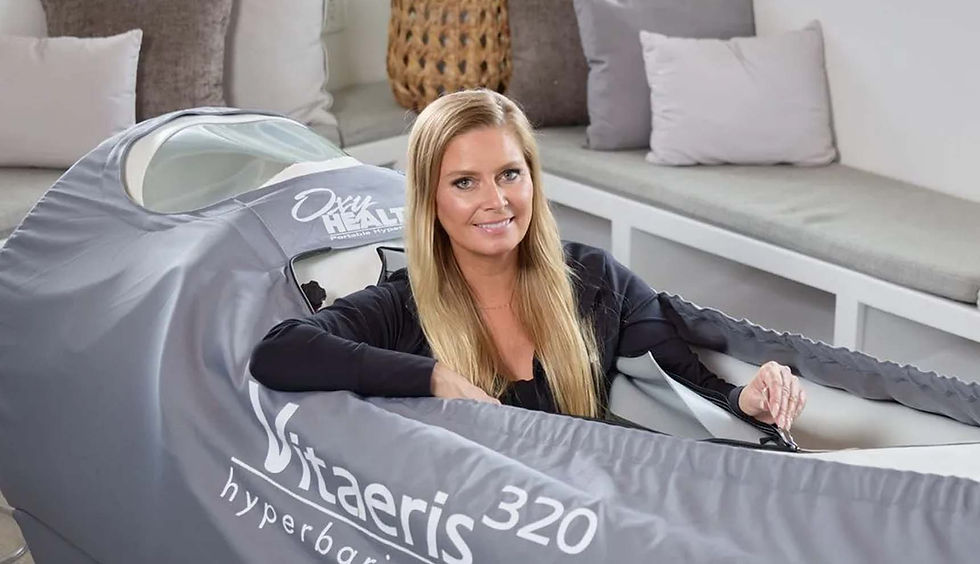
Product Lineup
OxyHealth’s range of chambers reflects different use cases, comfort preferences, and pressure requirements. The lineup includes:
Solace 210 – an entry-level portable hyperbaric chamber designed to help expand care beyond traditional clinical settings
Respiro 270 – a roomier model intended to enhance comfort while offering a lower cost of entry
Vitaeris 320 – the flagship model, widely recognized for helping redefine accessibility and safety in portable chamber design
Quamvis 320 – a hybrid exo-frame chamber with a roomier, unobstructed interior, reinforced by an added buckle and ballistic nylon outer layer
Fortius 420 – a steel clinical model capable of reaching pressures up to 3.0 ATA, built around an air-over-oxygen concept with an emphasis on safety
Fortius 420 EXP – a more flexible version of the Fortius 420, designed to allow installation through a standard 35-inch doorway
A Product Strategy Centered on Different Levels of Use
What stands out in the lineup is the breadth of environments OxyHealth appears to be addressing. Some chambers are geared toward portability and easier entry into hyperbaric therapy, while others are more clearly intended for clinical settings with higher pressure capabilities. That range suggests the company is not approaching hyperbaric technology as a one-size-fits-all category.
Instead, OxyHealth seems to recognize that users may prioritize different things: affordability, interior space, portability, structural reinforcement, or pressure capacity. The result is a portfolio that may appeal to both first-time adopters and more advanced professional environments.
This also reinforces the brand’s larger identity. Rather than focusing on a single hero product, OxyHealth presents itself as a long-term category leader with multiple chamber types designed around different practical needs.

The Broader Significance of the Brand
OxyHealth’s importance may lie less in any single feature and more in the role it has played in shaping expectations around hyperbaric access. By introducing portable chambers and continuing to emphasize safety, usability, and medical engineering, the company appears to have helped broaden the conversation around where and how hyperbaric therapy can take place.
That does not mean portability alone defines quality, nor does it remove the need for informed use. But it does suggest that the field has moved toward more flexible delivery models, and OxyHealth has remained closely associated with that shift.
OxyHealth is a featured brand in the Biohack Yourself Magazine Spring 2026 issue with Andrew Tate on the cover, available in stores and online on April 21, 2026.
Disclaimer:
Biohack Yourself Peer Review is an editorial, educational, and entertainment process for sponsored content. It is not a scientific peer review or regulatory evaluation. Please review our full Terms & Conditions and Legal Disclaimers


