

.jpg)

.jpg)


Stop Treating Pain as the Problem: How Greenberg Regenerative Medicine Looks Beyond Symptoms to Identify the Root Cause
- May 6
- 4 min read
Updated: May 8
Biohack Yourself APR 2026

Pain is often treated as the problem. A sore knee, a stiff shoulder, a lingering back issue are advised with rest, medication, or standard rehab. But while those approaches may provide temporary relief, they don’t address the main cause of the pain or explain why symptoms never fully resolve.
For many people, that cycle becomes familiar. Progress stalls. The conversation revolves around managing discomfort rather than resolving it.
Greenberg Regenerative Medicine, led by Scott R. Greenberg, MD, is built around a different question: what if the pain is not the issue itself, but a signal pointing to something deeper that hasn’t fully healed or stabilized? What if the biomechanics of the area in question are completely off?
Why Pain Relief Doesn’t Always Equal Resolution
Pain can decrease for many reasons. Inflammation may settle, activity levels may change, or the body may adapt to the issue. But in some cases, the underlying structure, whether it’s a ligament, tendon, or joint surface, may not have fully recovered.
This is where problems can persist quietly. A joint may feel “better,” but still lack stability. A tendon may no longer flare up daily, but remains vulnerable under load. Gradually, these gaps can lead to recurring discomfort or cause other parts of the body to work overtime to make up for the instabilities.
Focusing only on symptom relief may leave part of the picture unaddressed.
The Role of a Full-Body Evaluation
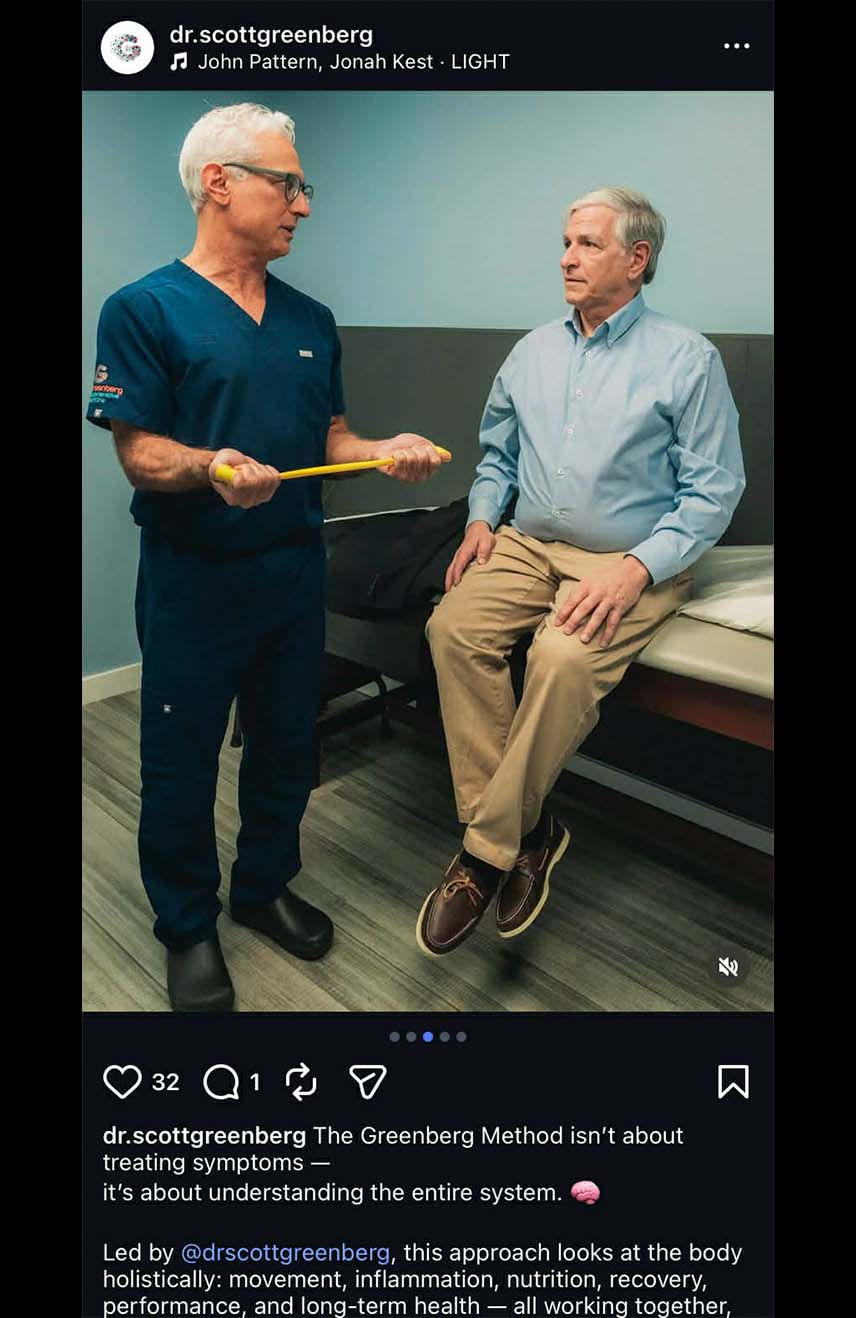
One of the defining elements of Dr. Greenberg’s approach is the full-body evaluation, often referred to as the Greenberg Method. Rather than isolating a single area of pain, the process looks at how different parts of the body interact… It’s a complete biomechanical evaluation, along with identifying damage that is not seen on MRI.
For example, knee pain may be influenced by hip mechanics. Shoulder issues may be related to posture or spinal stability. What appears to be a localized problem may reflect a broader pattern of imbalance or compensation.
By assessing movement, joint integrity, and how the body distributes stress, this type of evaluation could help identify contributing factors that are not always visible on standard imaging or in isolated exams.
The goal is not just to locate pain, but to understand the chain of events that may be driving it.

Repair-Focused Options That May Support Healing
Once potential root causes are identified, treatment may focus on supporting the body’s natural repair processes rather than simply suppressing symptoms. This is where regenerative therapies come into the conversation.
Platelet-Rich Plasma (PRP) uses concentrated components from a patient’s own blood and may support tissue repair in areas such as tendons, ligaments, and joints. It is often considered in cases where healing has slowed or plateaued.
Stem cell-based therapies are designed to deliver regenerative cells and growth factors to support tissue repair. These approaches are typically explored when deeper structural support is needed, particularly in joints or connective tissue.
VSEL therapy, which uses very small embryonic-like stem cells derived from the patient’s blood, is often discussed in the context of broader recovery and cellular support. It may be considered by individuals looking at both injury repair and longer-term resilience.
Prolotherapy takes a different approach by introducing a solution that may stimulate a localized healing response. This is often used in areas where ligaments or tendons may have become lax or weakened, potentially contributing to instability.
Each of these options is not treated as a one-size-fits-all solution. Instead, they may be selected and combined based on the body's overall functioning.
Why Some People Look Beyond Surgery
Surgery may be necessary in some cases, but not everyone wants to take that step immediately, especially when downtime, risk, and recovery are part of the equation.
For individuals exploring alternatives, non-surgical options that focus on tissue support and function may be appealing. Treatments at Greenberg Regenerative Medicine are designed to operate within that space, offering approaches that may cause less disruption to daily life.
This may be particularly relevant for people who want to stay active, maintain performance, or avoid long recovery periods whenever possible.
Who This Approach May Resonate With
A root-cause, repair-focused approach may appeal to individuals who feel caught between temporary relief and more invasive options.
This often includes people who:
Experience recurring pain despite previous treatment
Want to understand why an issue keeps returning
Prefer to explore non-surgical paths first
Are looking to maintain or regain an active lifestyle
It may also resonate with those who have been told their options are limited, but still feel there may be underlying factors worth exploring.

Reframing the Goal of Treatment
Shifting from treating pain to investigating its source changes how recovery is approached. Instead of asking, “How do I get this to stop hurting?” the question becomes, “What is preventing this from fully healing?”
Greenberg Regenerative Medicine builds its model around that shift. By combining detailed evaluation with regenerative therapies, the aim is to move closer to resolving the drivers of discomfort rather than managing them indefinitely.
For individuals navigating ongoing pain, that change in perspective may open the door to a different kind of conversation—one focused less on coping and more on understanding what the body may need to move forward.
Dr. Scott Greenberg and Greenberg Regenerative Medicine are featured in the Biohack Yourself Magazine Spring 2026 issue with Andrew Tate on the cover, available in stores and online on April 21, 2026.
Disclaimer:
Biohack Yourself Peer Review is an editorial, educational, and entertainment process for sponsored content. It is not a scientific peer review or regulatory evaluation. Please review our full Terms & Conditions and Legal Disclaimers


