

.jpg)

.jpg)


Menopause Isn’t the End; It’s a Reset Most Women Never Learn to Use
- Apr 3
- 4 min read
Why midlife can be a physiological turning point that, when handled correctly, is not a decline.
By Dr. Jessica Shepherd APR 2026

Longevity isn’t just about how long we live. It’s about how alive we feel. True vitality shows up in our energy, our hormones, our sleep, our muscles, our mood, and our overall sense of self. And for women, midlife is not a slow fade into invisibility or fragility. It is a powerful reset, an invitation to build strength, resilience, and joy from the inside out.
I say this not only as a midlife physician, but as a woman who has lived it.
My midlife wake-up call was even more surprising for me, as an OBGYN and menopause expert.
No one tells you that midlife doesn’t arrive with a dramatic crash. It sneaks in quietly. One day you’re doing “all the right things,” and the next you’re wondering why your sleep is trash, your workouts feel harder, your patience is thinner, and your body suddenly feels… unfamiliar.

For me, the signs weren’t catastrophic, but they were persistent. Fatigue that no amount of coffee could fix. Sleep that looked fine on paper but felt useless in practice. A body that didn’t respond the way it used to, despite discipline and knowledge. And the sneaky voice many women hear: Is this just how it is now?
I even had moments where I underestimated how profound this transition could be.
That’s when it hit me: if I was recalibrating in real time, how many women were struggling silently, thinking they were failing instead of realizing their physiology had changed?
In my practice, I see women who are accomplished, intelligent, and deeply capable yet completely blindsided by midlife.
They say things like:
“I don’t recognize my body anymore.”
“I’m doing more and getting less.”
“I feel tired, but it’s deeper than fatigue.”
“I was told this was normal, but it doesn’t feel acceptable.”
And here’s the truth: they’re not broken. They’re under-informed.
Perimenopause and menopause are not simply the end of reproduction—they are a whole-body transition. As ovarian hormone production declines, nearly every system feels the ripple effect: metabolism, brain health, bone density, cardiovascular health, sleep regulation, mood, and muscle mass.
This isn’t a decline. It’s a physiological turning point. And when handled correctly, it can be one of the most powerful health resets of a woman’s life.
Let’s talk about movement, not as punishment, but as medicine.
Exercise remains one of the most universally effective longevity tools we have. But for women in midlife, it becomes essential. Regular movement improves mitochondrial function (your energy factories), reduces inflammation, supports hormonal balance, and enhances brain health.
Strength training deserves its own standing ovation. As estrogen declines, bone density and lean muscle mass are at risk. Resistance training helps preserve both, reducing fracture risk, improving insulin sensitivity, and supporting metabolic health. Translation? You stay strong, capable, and independent longer.
And no…you don’t need to live in the gym. Consistency beats intensity every time.
One of the most overlooked aspects of female longevity is ovarian health.
When ovarian hormone production declines, the impact extends far beyond hot flashes.
Estrogen plays a role in protecting bones, the brain, the heart, and even the gut. Ignoring this shift doesn’t make it disappear. It just makes the consequences louder.
Hormone replacement therapy (when appropriate and individualized) is not about vanity or denial of aging. It is a medical tool that can protect long-term health when used thoughtfully, alongside nutrition, movement, stress management, and sleep support.
Midlife care should never be one-size-fits-all, but it should be proactive.
Sleep disruption is one of the most common—and debilitating—symptoms of perimenopause and menopause. Sleep loss is an energy crisis and not a luxury.
And no, it’s not just “getting older.”
When sleep suffers, everything suffers: metabolism, mood, memory, immune function, and cardiovascular health. Restoring sleep means addressing hormones, nervous system regulation, stress, and lifestyle patterns together. When women start sleeping again, they often say the same thing: I feel like myself.
That’s not a coincidence. That’s physiology responding to support.
Midlife is where power returns if you claim it, and here’s what I want every woman to know: midlife is not the beginning of the end. It’s the moment you stop outsourcing your health to outdated narratives.
This is the chapter where you:
Build muscle instead of shrinking
Protect your brain instead of fearing decline
Prioritize sleep without apology
Use modern medicine and lifestyle tools
Redefine strength on your own terms
Menopause is not something to “get through.” It’s something to get through with intention.

Takeaway Tips to Get on Track in Midlife
Lift heavy things regularly – Strength training 2–3 times per week is non-negotiable for longevity.
Move daily – Walking, mobility, and consistency matter more than perfection.
Fuel for hormones – Prioritize protein, fiber, and micronutrients that support metabolic and hormonal health.
Protect your sleep – Treat sleep restoration as medical care, not a bonus.
Have informed conversations – About hormones, longevity, and what your body actually needs now.
Build community – Midlife is not meant to be navigated alone.
If this resonates, I invite you to go deeper.
“Generation M” is my book, written to help women understand this transition with clarity, confidence, and empowerment, without fear or fluff. Modern Meno, the community I created, exists so women never have to walk this journey alone. Because when women are informed, supported, and invested in their health together, midlife becomes a beginning and not an ending.
Menopause isn’t the end. It’s the reset most women were never taught how to use.
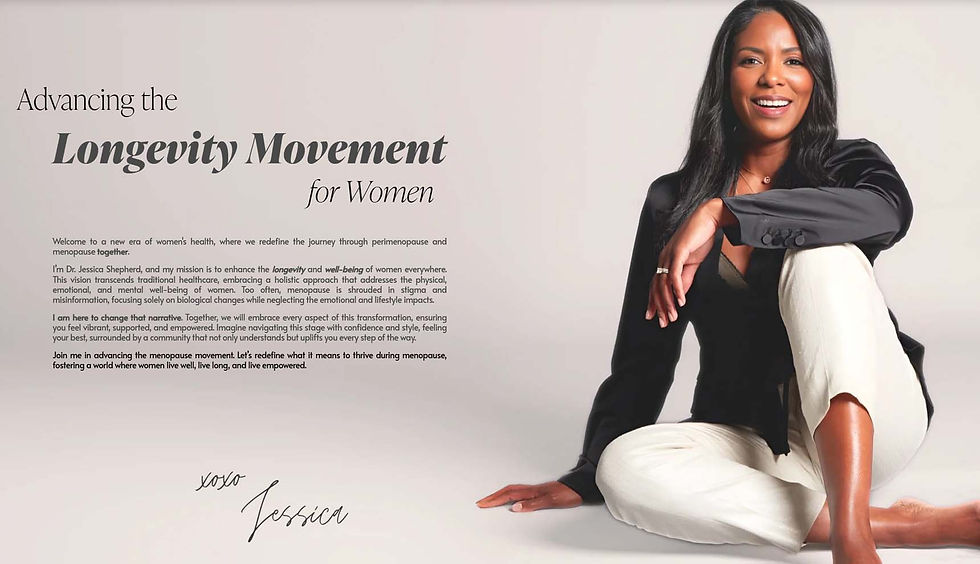
Dr. Jessica Shepherd, MD, MBA, FACOG, is a board-certified OB/GYN, Chief Medical Officer of Hers, and author of “Generation M,” the chart-topping book redefining women’s health. A leading voice in women’s wellness and longevity, she’s a regular on “Good Morning America” and frequently featured on “The Today Show,” CNN, “LIVE with Kelly and Mark,” Vogue, Cosmopolitan, and more. With a no-nonsense approach and deep medical expertise, she’s helping women cut through the noise, take control of their health, and feel their best at every stage of life.
Disclaimer:
Contributor content reflects the personal views and experiences of the author and does not necessarily represent the views of Biohack Yourself Media LLC, Lolli Brands Entertainment LLC, or any of their affiliates. Content is provided for editorial, educational, and entertainment purposes only. It is not medical or dental advice. Always consult qualified professionals before making health decisions. By reading, you agree to hold us harmless for reliance on this material. See full disclaimers at www.biohackyourself.com/termsanddisclaimers


