

.jpg)

.jpg)


Dr. Maxine Thérèse and the Future of Human Development
- Jun 10
- 3 min read
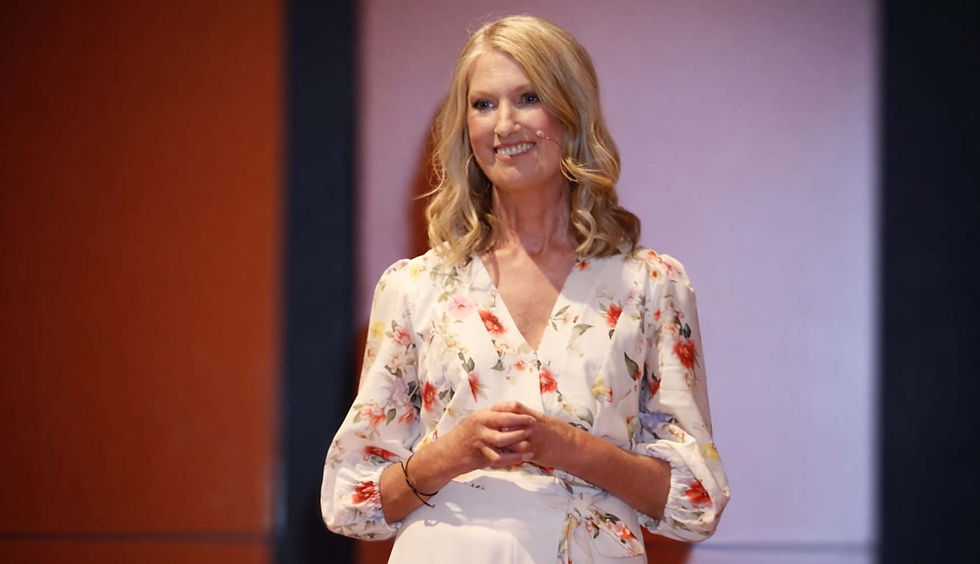
Dr. Maxine Thérèse is an internationally recognised philosopher, child development researcher, educator, and founder of Childosophy™, a comprehensive framework that redefines how human development is understood. Her work challenges conventional models by proposing that children do not simply inherit the world, but actively expand the possibilities of human consciousness through the way they grow, relate, and express themselves.
Her perspective on development as an evolving, integrative process is reflected in "The New Woo", where emerging ideas around consciousness, relational intelligence, and human potential are being reexamined through both lived experience and expanding scientific awareness. The film explores how concepts once considered peripheral are becoming central to how we understand health, growth, and the human experience.

Rethinking Childhood as a Developmental Intelligence
At the core of Dr. Thérèse’s work is a fundamental shift in how childhood is viewed. Rather than seeing development as something that happens to a child, she frames it as something the child actively participates in, shaped through relationship, environment, and the ongoing organisation of the nervous system.
Her research explores how early experiences become biologically encoded, influencing perception, behavior, and identity across a lifetime. Within this view, the parent–child relationship is not simply supportive, but foundational, acting as the primary environment through which safety, meaning, and possibility are first established.
This perspective reframes common behavioral challenges such as emotional intensity, resistance, or dysregulation. Rather than signs of disorder, they are understood as adaptive responses, the nervous system organizing itself in relation to perceived conditions. The body, in this sense, is not malfunctioning but responding intelligently in pursuit of survival and connection.
The Development of Childosophy™
Childosophy™ emerged from over two decades of research, clinical observation, and lived experience, including Dr. Thérèse’s own journey through motherhood. Her children became a direct source of insight, revealing the importance of meeting each individual as they are, rather than asking them to conform to inherited expectations.
At the center of this framework is the Foundational Needs Model, a developmental map that describes how human needs organize and reorganize through the nervous system over time. Drawing conceptually from both modern science and traditional systems of understanding, it offers a way to interpret behavior as meaningful information rather than dysfunction.
One of her key contributions is the idea that development is reciprocal. Children are shaped by the adults around them, but they also evoke unresolved patterns within those adults, creating opportunities for integration, growth, and healing across generations.

Development as an Ongoing Evolution
Dr. Thérèse’s work sits at the intersection of neuroscience, epigenetics, relational psychology, and human meaning-making. Through her doctoral research, she articulated a theory of the soul as a developmental construct, describing it as an organizing intelligence that integrates body, mind, and experience over time.
Her approach emphasizes that development is not linear or hierarchical, but adaptive and dynamic. Stability and vulnerability exist in constant relationship, and what may appear as regression often reflects a system returning to unresolved areas in order to integrate them. This process, when supported, builds nervous system flexibility and lays the foundation for resilience, awareness, and expanded human potential.
She is also the author of "The Push for a Child Philosophy" (2017), and her work informs practitioner training, parenting programs, and educational initiatives internationally.
Dr. Thérèse’s contribution to "The New Woo" brings a developmental lens to the broader conversation around consciousness and transformation. Her work highlights childhood as the point where patterns are first formed and possibilities first emerge, offering a perspective that connects individual growth with the evolution of human potential itself.
Disclaimer:
The information provided here is for entertainment and educational purposes only. It is not intended to substitute medical professional advice, diagnosis, or treatment. Always seek the advice of your physician or another qualified health provider with any questions you may have regarding a medical condition. More details: www.biohackyourself.com/termsanddisclaimers


