At the outset of my career, I thought of dentistry the way most dentists do. We look at teeth, gums, X-rays, the bite, and the patient's symptoms, and then we try to figure out what is going wrong. But I saw unexplained symptoms all over the place. Over time, I became increasingly interested in something we don't traditionally see very well: what is actually happening when the teeth come together and the jaw starts moving?
That question led me into Disclusion Time Reduction, using computerized bite-force analysis and surface electromyography (sEMG) to quantify bite metrics. It changed the way I practice.
I'm not interested in simply looking at a patient's bite and deciding whether it "looks good." I wanted to know what the system is actually doing as a whole because the system is dynamic … not static. We chew, swallow, talk, clench, grind, and move our jaws thousands of times a day. Every one of those movements involves teeth, muscles, joints, nerves, and forces interacting with each other.
So I started asking a different question: What if we could measure that interaction? That's where things got really interesting.
Computerized bite-force analysis allows us to objectively evaluate where and when teeth contact and how forces are distributed. Surface EMG allows us to measure muscle activity and see how hard muscles such as the masseter and temporalis are working. Suddenly, something that was previously invisible became measurable … and that is what really matters.
Traditional bite evaluation often gives us a snapshot. We have a patient close their teeth together, examine the contacts with paper, and make a judgment about what we see. But that's only one moment in time.
The more I studied Disclusion Time Reduction, the more interested I became in what happens after the teeth come together. How long do the back teeth remain in contact during jaw movement? How quickly do they separate? What happens to muscle activity while that is occurring?
DTR focuses on reducing the amount of time back teeth remain in contact during certain movements. The goal isn't simply to make a tooth "hit less." It's to understand whether the patient's bite is contributing to an inefficient or excessive functional pattern and, when appropriate, make a precise change.
That's a very different philosophy from simply adjusting a bite because we see a mark with paper. I'm interested in the physiology and neurology behind the mark.
What really pulled me deeper into this wasn't the technology. It was my patients.
We see people with headaches and migraines, chronic facial and myofascial pain, clenching and grinding, sleep-related issues, inner ear issues, joint issues, and persistent discomfort with no solution after seeing multiple providers.
And then there are the patients who simply say, "Something doesn't feel right." In fact, one of the most important lessons I've learned is that not everything is a dental problem. But I do know the masticatory system is far more interconnected with the rest of the body than we have traditionally appreciated.
When we combine a patient's history with objective measurements of muscle activity and bite-force dynamics, we can often identify functional patterns that aren't obvious during a conventional dental examination. And that gives us another piece of the puzzle.
THIS IS WHERE I THINK DENTISTRY NEEDS TO CHANGE
One of the things I love about the biohacking world is the willingness to measure. We measure heart rhythms, blood pressure, glucose, oxygen levels, sleep, and countless other physiological variables. Yet dentistry has historically relied heavily on visual examination and subjective interpretation when evaluating one of the most dynamic systems in the body. Why shouldn't we measure it? That was my question.
Technology doesn't replace clinical judgment. But it does make clinical judgment better. If a patient has unusually high muscle activity, I want to know. If their bite forces are distributed in a way that concerns me, I want to understand why. If I make a carefully considered occlusal change, I want to know whether the physiology and neurology changed afterward.
That creates something I find incredibly valuable: a feedback loop. Measure. Intervene. Measure again. Instead of simply saying, "I think this is better," we can demonstrate that something actually changed.
I'M NOT REALLY INTERESTED IN TECHNOLOGY
Ironically, I don't think my fascination with all of this is really about technology. I'm interested in solving problems.
I like the patient who doesn't fit neatly into a textbook. I like the person who has been told, "Everything looks normal," but knows that something doesn't feel normal. And I like being able to show a patient something happening inside their own body that they could feel but couldn't previously see.
A patient can feel tension in their jaw, but they can't see their muscles working harder than they should. They can feel that something is different when they bite, but they can't see how their forces are being distributed.
"The system is dynamic, not static."

Technology gives us another way to investigate those experiences, and to me, that's the real promise of this approach. It's not about claiming we have discovered the answer to every headache, migraine, ear symptom, sleep problem, or pain condition. It's about being willing to ask better questions and investigate relationships that may have been overlooked.
That's what I think being a biohacker is really about: curiosity, measurement, experimentation, and the willingness to challenge an assumption and then test it.
I've spent most of my career looking at teeth. Now I'm much more interested in what happens between the teeth, inside the muscles, and during movement. The bite isn't just something we look at. It's something the body is constantly using. And once you start measuring it, you realize just how much it has been telling you all along.
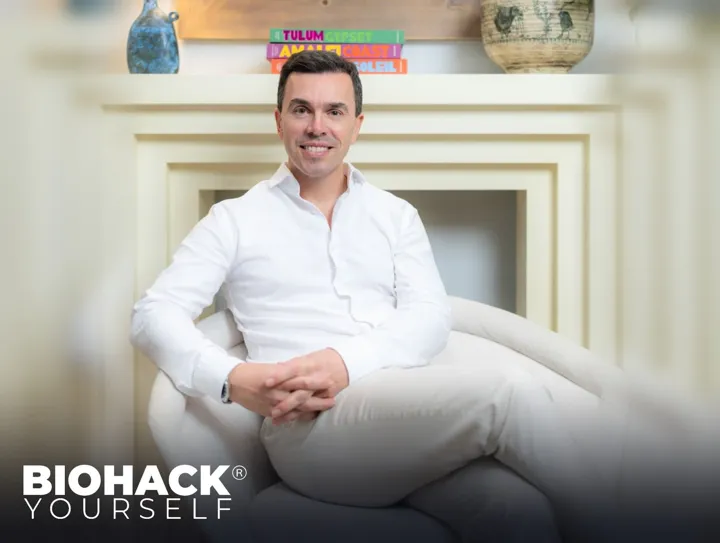
Dr. Cody Kriegel, DDS, FIAOMT, is the founder of Vios Dental and a nationally recognized leader in biological and integrative dentistry. A University of Iowa College of Dentistry graduate, he is an accredited Fellow of the IAOMT, a Fellow of the ICOI, a certified Real Biodentist through Biodentistry 3.0, and U.S. Ambassador for Swiss Dental Solutions. His clinical focus includes ceramic implantology, advanced surgery, regenerative therapies, and Disclusion Time Reduction using computerized bite-force analysis. Dr. Kriegel co-authored the IAOMT Jawbone Position Paper and lectures internationally. In 2026, Incisal Edge named him to its 40 Under 40 class for innovation in modern dentistry.
Dr. Cody Kriegel, DDS, FIAOMTis a featured contributor in the Biohack Yourself Mouth Magazine Fall 2026 issue with Dr. Gerry Curatola, DDS, on the cover, available in stores and online on November 17, 2026.
Disclaimer:
Contributor content reflects the personal views and experiences of the author and does not necessarily represent the views of Biohack Yourself Media LLC, Lolli Brands Entertainment LLC, or any of their affiliates. Content is provided for editorial, educational, and entertainment purposes only. It is not medical or dental advice. Always consult qualified professionals before making health decisions. By reading, you agree to hold us harmless for reliance on this material. See full disclaimers at www.biohackyourself.com/termsanddisclaimers